Vegetation Management
Forestry Mulching Myrtle Beach
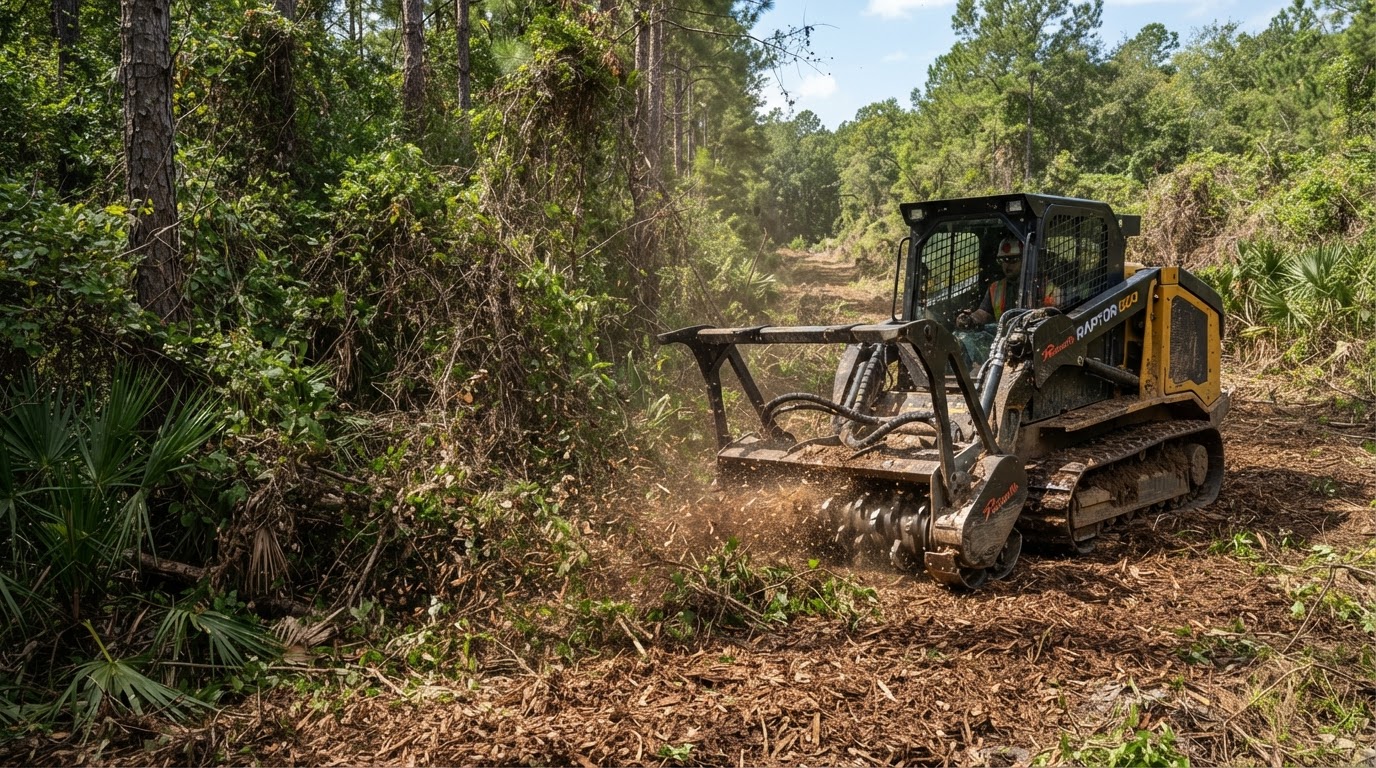
Forestry mulching is a vegetation management method that processes trees, brush, and undergrowth into mulch in a single pass, leaving the organic material onsite. It is well suited for overgrown properties, access opening, and land management — but it does not remove below-surface roots or create a construction-ready surface on its own. The right application depends on the vegetation, the terrain, the equipment access, and what the land will become. Share your property details and we will discuss whether forestry mulching fits your project.
Forestry Mulching Services near Myrtle Beach
Forestry mulching addresses a specific set of land management needs. Understanding where it fits — and where it does not — helps you choose the right approach.
Overgrown Property and Brush Management
Dense brush, smaller vegetation, and overgrown acreage are prime candidates for forestry mulching. The mulcher processes the growth into a layer of organic material that stays onsite, reducing the need for hauling and disposal. Selective work areas can be targeted while leaving other sections undisturbed. Property access routes may be opened through the vegetation as the mulcher advances.
Forestry Mulching for Rural Land in Myrtle Beach
On rural properties, forestry mulching opens access pathways, manages vegetation across larger areas, and maintains previously cleared sections. The mulched material left onsite can help suppress regrowth and reduce erosion on slopes. The planned property use — whether hunting land, pasture, access, or future development — determines how much of the property is mulched and what follow-up work may be needed.
Mulching Versus Traditional Land Clearing
Forestry mulching and traditional clearing handle vegetation differently. Mulching processes vegetation into mulch that stays onsite, minimizing surface disturbance but leaving stumps and roots below grade. Traditional clearing removes trees and brush, then hauls or burns the debris, leaving bare ground that can be graded and built on. The choice depends on the vegetation, the terrain, the intended use, and whether a construction-ready surface is needed.
Planning Forestry Mulching near Myrtle Beach
Mulching feasibility depends on the vegetation, the terrain, and the equipment access. These planning considerations help define whether mulching is the right approach.
Vegetation Size and Equipment Access
The size and density of the vegetation determine what the mulching head can process. Smaller trees, brush, and undergrowth are well suited; very large trees may exceed the equipment’s capacity. Terrain — slopes, wet ground, rocky areas — affects how the tracked carrier moves across the site. Existing obstacles and retained vegetation define the work area boundaries. Equipment access from the road to the vegetation must be wide and stable enough for the mulcher.
Mulch Material and Future Land Use
The mulched organic material remains onsite as a surface layer. For land management, this can be beneficial — suppressing regrowth and reducing erosion. For future construction, the mulch layer and the roots below it may need to be addressed before grading or building pad preparation. If the area will be built on, the follow-up grubbing and grading scope should be discussed alongside the mulching so the full project is planned, not just the vegetation phase.
Forestry Mulching Considerations in Myrtle Beach
Forestry mulching has real limitations. Understanding them helps you decide when mulching is appropriate and when a different approach may be needed.
Understanding Mulching Limits
- Root systems remain below the surface after mulching
- Large stumps may not be fully processed by the mulching head
- Buried debris and organic material are not removed
- Terrain and soil conditions affect equipment mobility
- Wet ground can limit when and where the mulcher can operate
- Vegetation type and size determine what can be processed
- Access constraints may prevent the mulcher from reaching the site
- Follow-up clearing or grubbing may be needed for construction use
We do not publish production rates per hour or per acre — each property is evaluated based on its actual vegetation, terrain, and access conditions.
Forestry Mulching Questions near Myrtle Beach
Discuss Forestry Mulching near Myrtle Beach
Share your property location, the vegetation type and density, the terrain, equipment access, and your intended use for the land. Photographs taken where it is safe to do so help assess whether mulching is the right approach.
Related Services
Additional related pages — including Right-of-Way & Fence Line Clearing and Hunting Land & Food Plot Clearing — will be linked here once those pages are published.